

Urban Renovations Blog
Low-Voltage Lighting: Security and Ambiance for Your New Hardscape
September 10, 2026 Urban Renovations | Appleton, WI | USA
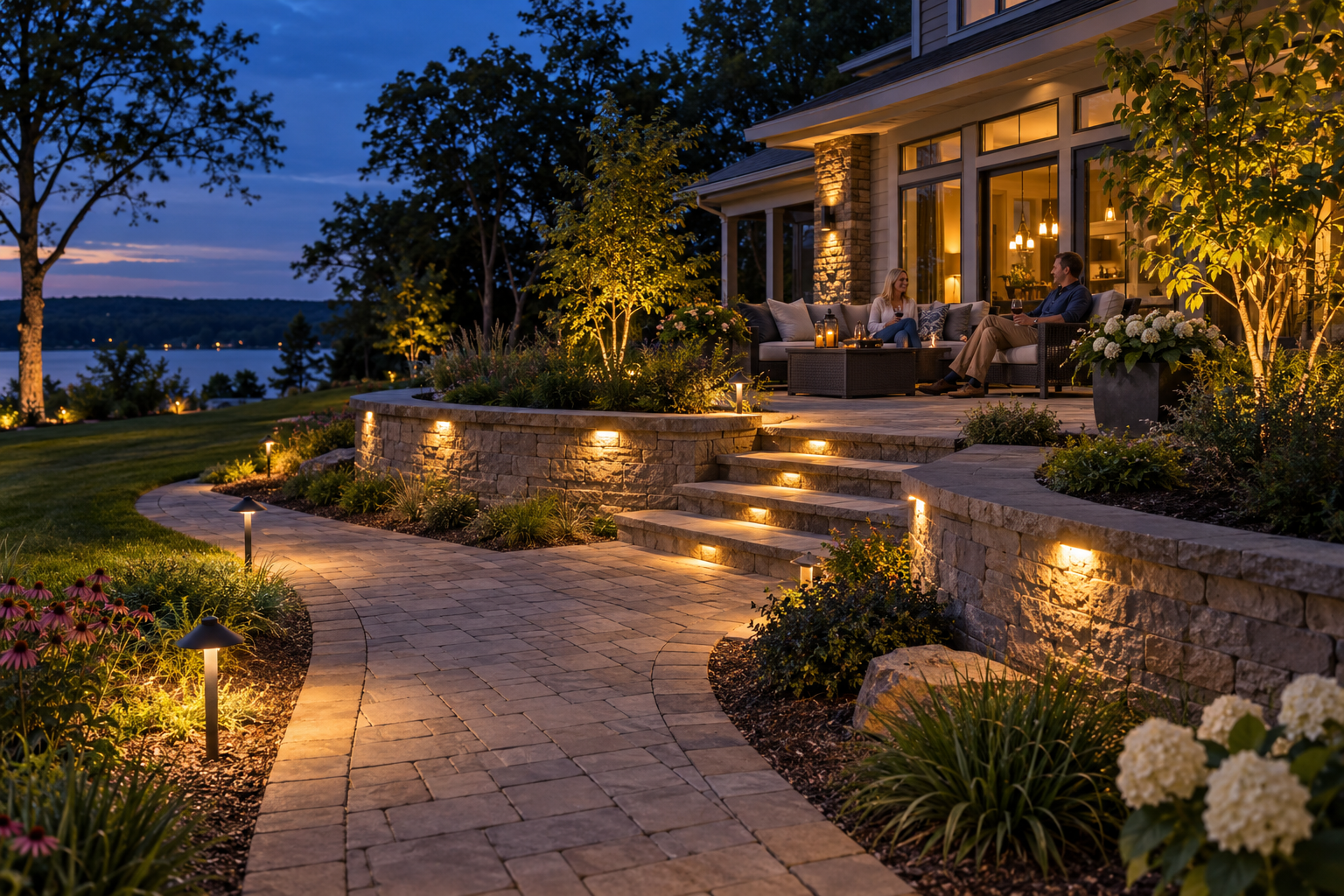
Have you ever finished planning a beautiful patio or walkway only to realize that much of its appeal could disappear as soon as the sun goes down? Lighting is easy to treat as a finishing touch, but we believe it deserves consideration much earlier in the hardscape design process. A patio, walkway, retaining wall, seating area, or outdoor kitchen should work just as thoughtfully after sunset as it does during the day. At Urban Renovations, we look at low-voltage lighting as a combination of function and atmosphere. It can help people see steps and pathways, add useful illumination around gathering areas, reduce dark spots, and highlight the materials and details that make a hardscape interesting. For homeowners considering an Outdoor Kitchen Appleton project or another outdoor living upgrade, planning the lighting at the same time as the hardscape can also make it easier to integrate fixtures and wiring cleanly into the finished design.
What Is Low-Voltage Landscape Lighting and How Does It Work?
Low-voltage landscape lighting is an outdoor lighting system designed to illuminate walkways, patios, steps, retaining walls, planting areas, and other landscape features using a lower operating voltage than standard household lighting. A transformer reduces the incoming household voltage to the voltage required by the landscape lighting system, and outdoor-rated wiring distributes power to individual fixtures. Low-voltage systems can include path lights, step lights, under-cap fixtures, accent lights, and other designs suited to specific outdoor areas. LED fixtures are commonly used because they provide efficient, directional illumination and can have a long operating life. Controls such as timers and photosensors can also determine when the lights operate. When lighting is planned during hardscape construction, wiring routes and fixture locations can often be incorporated more cleanly into steps, walls, patios, and outdoor living areas. The goal is not to make the entire property extremely bright. Good low-voltage lighting puts useful light where people need it while also highlighting the hardscape and creating a comfortable atmosphere after dark.
What Are the Benefits of Low-Voltage Outdoor Lighting?
A good lighting plan can serve several purposes at the same time. First, it improves visibility. Walkways, steps, changes in elevation, patio edges, and entrances are easier to identify when useful illumination is placed nearby. Second, lighting can make outdoor living areas more practical after sunset. If you have invested in a patio, dining space, seating wall, or outdoor kitchen, you probably want to enjoy it for more than just the daylight hours. Lighting can also contribute to security by improving visibility around selected parts of the property. The goal is not necessarily to illuminate every square foot of the yard. Strategic placement around entrances, paths, and commonly used spaces can reduce very dark areas.
Finally, hardscape lighting creates ambiance. Carefully positioned fixtures can reveal stone textures, paver patterns, walls, plants, and architectural details that may otherwise disappear at night. The best designs balance all these goals rather than focusing on brightness alone.
Does Landscape Lighting Improve Home Security?
Outdoor lighting can support a home's overall security strategy by improving nighttime visibility. Entrances, walkways, gates, and frequently used areas are obvious places to consider. Lighting these spaces can help homeowners see their surroundings when arriving home after dark and make it easier to notice unexpected activity. Motion-responsive lighting may also be useful in selected locations where continuous illumination is unnecessary. However, we would not describe landscape lighting as something that guarantees security or prevents crime. It is one component of a broader approach that may also include locks, cameras, alarms, landscaping decisions, and other measures. Controls can make outdoor lighting more practical as well. The U.S. Department of Energy discusses lighting controls such as occupancy sensors, timers, and photosensors as tools that can reduce unnecessary lighting operation and provide light when it is actually needed. Thoughtful placement is more useful than simply installing the brightest fixtures available.
Does Outdoor Lighting Make Walkways and Steps Safer?
Outdoor lighting can improve visibility around walking surfaces, particularly where there are steps or changes in elevation. Imagine walking from a patio toward your house at night. If the edge of a step blends into the surrounding pavers, it may be harder to judge where the walking surface changes. Step lights, wall lights, and carefully positioned path lights can help define those transitions. Retaining walls, seating walls, pathway intersections, entrances, and transitions between different outdoor surfaces may also benefit from illumination. Brightness alone does not automatically create better visibility. Poorly aimed fixtures can cause glare, which can make it more difficult for your eyes to adjust between bright and dark areas.
We prefer to think about what people actually need to see. The edge of a step, the direction of a walkway, or the entrance to a patio may need illumination without lighting the entire surrounding yard.
Where Should Lights Be Placed in a Hardscape?
Fixture placement should follow how the outdoor space will actually be used. Steps are one of the first areas we consider because they involve changes in elevation. Fixtures can sometimes be incorporated into risers, adjacent walls, or nearby hardscape elements. Walkways may benefit from lighting at turns, transitions, and other areas where people need to understand the direction of travel. Retaining walls and seating walls provide opportunities for integrated fixtures. Under-cap lighting, for example, can direct light downward without placing a visible fixture directly in a person's line of sight.
Patio entrances, doors, grilling areas, and outdoor kitchens have different requirements because they combine movement with specific activities. We also consider focal points. Stone columns, textured walls, specimen plants, or architectural details may look particularly attractive with subtle accent lighting. Planning these locations during hardscape design can make the final installation feel intentional rather than added afterward.
What Types of Low-Voltage Lighting Work Best With Hardscapes?
Different fixtures solve different problems. Step lights are designed to illuminate stairs and elevation changes. Depending on the design, they can be incorporated into risers or nearby walls. Under-cap lights can work well beneath the caps of retaining walls and seating walls. They direct light downward, which can create a soft effect while helping illuminate nearby surfaces. Path lights provide illumination along walkways and landscape transitions. They should be positioned thoughtfully so the property does not become a repetitive line of fixtures.
Accent lights are useful for highlighting trees, stonework, architectural details, and selected landscape features. In-ground fixtures may be appropriate for certain architectural or landscape applications where the design calls for illumination from below. Task lighting serves a more functional purpose. Cooking and food preparation areas, for example, need enough usable light for people to see what they are doing. A complete hardscape may use several fixture types rather than relying on one style everywhere.
How Can Lighting Improve the Ambiance of a Patio?
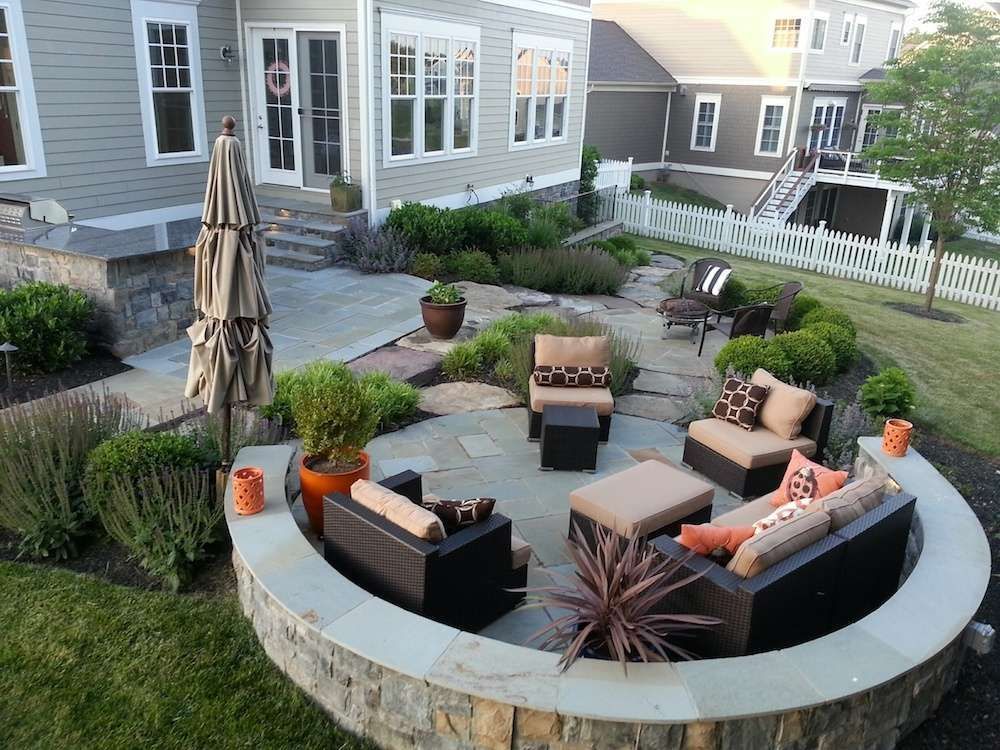
A patio feels very different at night than it does during the afternoon. Good lighting embraces that difference rather than trying to recreate daylight. Soft illumination around seating walls can define the edge of the patio. Accent lights can reveal stone textures. Carefully positioned fixtures can make nearby plants or architectural features visible without overpowering the gathering area. Layering different types of light creates depth.
If every surface receives the same brightness, the space can feel flat. When some areas are softly illuminated, and others remain darker, the eye naturally moves between focal points. We also think about where people will sit. A fixture that looks attractive from across the patio may become uncomfortable if it shines directly into someone's eyes from a chair.
Ambiance is therefore as much about controlling light as adding it. The goal is a patio where people can move comfortably, see each other, and appreciate the surrounding hardscape without feeling as though they are sitting beneath a floodlight.
How Much Lighting Does an Outdoor Kitchen Need?
An outdoor kitchen requires a combination of functional and ambient lighting. Food preparation surfaces need enough illumination to see ingredients, utensils, and cooking areas clearly. Grill areas also require practical lighting so the person cooking can see what they are doing after sunset.
Dining and seating areas have different needs. These spaces can usually feel more comfortable with softer ambient illumination. Walkways around the kitchen should also be considered, especially when there are steps or changes in surface elevation.
When we think about an Outdoor Kitchen Appleton homeowners can comfortably use at night, we do not rely on one bright fixture to handle everything. Instead, we consider where food will be prepared, where people will cook, how guests will move through the space, and where everyone will sit. Combining task and ambient lighting allows each part of the outdoor kitchen to serve its purpose without making the entire area unnecessarily bright.
Why Plan Lighting When Building an Outdoor Kitchen Appleton Homeowners Can Use After Dark?
Planning lighting before construction can make the finished outdoor space much more cohesive. If we already know where countertops, seating, pathways, steps, and cooking equipment will be located, we can consider lighting requirements as part of the overall layout.
That may make it easier to plan wiring routes, fixture locations, and access before hardscape materials are installed. It can also reduce the need to modify completed surfaces later.
For an Outdoor Kitchen Appleton project, we want homeowners to think about how they will actually use the space after sunset. Where will someone stand while grilling? Where will guests enter? Are there steps between the kitchen and patio? Will people dine nearby? Those questions influence lighting placement. A kitchen that looks beautiful during the day should not become difficult to use simply because daylight has disappeared.
Is LED Lighting Good for Outdoor Hardscapes?
LED technology is well suited to many outdoor lighting applications because of its efficiency, long operating life, and ability to direct light where it is needed. The U.S. Department of Energy explains that LEDs use significantly less energy than incandescent lighting and can last much longer. DOE also notes that LEDs emit light in specific directions, which can reduce the need for reflectors and diffusers that trap light in some other lighting systems.
Directional lighting is particularly useful around hardscapes. We may want light directed downward along a wall, toward a step, or onto a specific architectural detail instead of spreading broadly in every direction. LED systems also work with many modern lighting controls, although compatibility should always be confirmed for the specific fixtures, transformer, and controls being installed.
Can Low-Voltage Lighting Be Automated?
Yes. Outdoor lighting can be paired with different controls depending on how homeowners want the system to operate. Timers can turn lights on and off according to a schedule.
Photosensors can respond to available daylight, allowing lighting to activate as outdoor conditions become darker. Motion or occupancy-based controls may be appropriate for selected applications where lighting is only necessary when someone is nearby.
The U.S. Department of Energy recognizes timers, photosensors, and occupancy sensors among the controls that can help reduce lighting use when illumination is unnecessary. Different areas do not necessarily need identical schedules. Pathway lights might operate during the evening, while a security-related fixture could respond to motion. Entertainment lighting may only be necessary when the patio is being used. Controls allow the system to better match the homeowner's routine.
How Do You Avoid Too Much Outdoor Lighting?
More outdoor light does not automatically mean better outdoor lighting. One of the most common design problems is glare. If a fixture points directly toward people's eyes, the brightness can become uncomfortable and may actually make surrounding darker areas harder to see. Light should also stay focused on the property and surfaces it is intended to illuminate. The National Park Service recommends responsible outdoor lighting practices that include using light only where and when it is needed, directing light downward, choosing appropriate light levels, and using controls such as timers and motion sensors where suitable. These principles help reduce unnecessary artificial light at night. For residential hardscapes, the same idea is useful.
Illuminate the step, not the entire yard. Highlight the wall without shining into a neighboring window. Give the cooking area enough functional light without turning the patio into an overly bright space. Purposeful lighting generally creates a better atmosphere than excessive brightness.
What Color Temperature Is Best for Outdoor Lighting?
Color temperature describes whether white light appears warmer and more yellow or cooler and more blue. There is no single color temperature that is automatically right for every outdoor space. Warmer-looking light often works comfortably around patios, stonework, seating, and other areas designed for relaxation. It can complement many natural hardscape materials and create a welcoming appearance. Task-oriented areas may have different requirements because visibility is the priority.
Consistency is also important. Mixing dramatically different color temperatures throughout one small patio can make the design feel disconnected. We consider the hardscape materials, architecture, surrounding landscape, and purpose of each fixture when thinking about light appearance. The goal should be to create a coherent nighttime environment rather than choosing a color temperature based only on a number printed on the package.
Should Landscape Lighting Be Installed Before or After Hardscaping?
Whenever possible, we recommend thinking about lighting before or during hardscape planning. That does not mean every fixture must be finalized immediately. It means the project should account for the possibility of lighting. Early planning can help determine wiring routes, transformer locations, fixture positions, and places where sleeves may be useful beneath paved areas. Integrated step or wall lights are also easier to consider before those structures are completely finished.
This can be especially valuable around retaining walls, seating walls, stairs, patios, and outdoor kitchens. Existing hardscapes can often be retrofitted with lighting, so homeowners who already have a patio should not assume they have missed their opportunity. However, integrating lighting into a new hardscape from the beginning can provide more design flexibility and may produce a cleaner finished appearance.
How Does Lighting Highlight Hardscape Design?
A hardscape that looks impressive during the day can take on an entirely different character at night. Directional light can reveal the texture of natural stone or masonry. Under-cap fixtures can create a soft line beneath a seating wall. Accent lights can make columns, trees, or architectural features stand out against darker surroundings. Paver patterns may also become more noticeable when light moves across the surface at an angle. We use lighting to establish visual hierarchy. Not every feature needs to become a focal point. Sometimes the best result comes from highlighting two or three important elements while allowing the rest of the landscape to remain quieter. This creates contrast and depth. It also means homeowners can continue enjoying the craftsmanship of their hardscape long after daylight disappears.
What Should You Consider Before Installing Low-Voltage Lighting?
Start by thinking about how you use the property. Where do people walk after dark? Which steps are difficult to see? Where do you entertain? Are there entrances or access points where better visibility would be helpful? Next, think about the hardscape itself. Retaining walls, seating walls, patios, pathways, outdoor kitchens, and landscape transitions may each create opportunities for integrated fixtures. Electrical planning matters too. Transformer capacity, wiring routes, controls, and future expansion should be considered as part of the system design. Maintenance access should not be forgotten. Fixtures and electrical components should remain serviceable after landscaping and hardscaping are complete.
Finally, consider your neighbors and surrounding environment. Light should be directed where it is useful rather than spilling unnecessarily beyond the intended area. Thinking about the complete outdoor space usually produces a better result than purchasing fixtures one at a time without an overall plan.
Why Choose Urban Renovations For Your Outdoor Lighting Needs
At Urban Renovations, we have more than a decade of experience helping homeowners create outdoor spaces that combine practical construction with thoughtful design. We do not see lighting as separate from the hardscape. When appropriate, it can be considered alongside patios, walkways, retaining walls, seating areas, and other outdoor features so the finished space works together as one design.
Our 3D project visualization process can also help homeowners understand how major hardscape elements will relate to one another before construction begins. As a Unilock Authorized Contractor, we bring certified installation knowledge to projects involving pavers and related hardscape systems.
For an Outdoor Kitchen Appleton homeowners want to use for evening cooking and entertaining, we can think beyond the kitchen structure itself. We consider how people reach the space, where they gather, where elevation changes occur, and how the overall hardscape functions. We also believe clear communication matters. Homeowners should understand why particular design decisions are being considered and how those choices support the way they plan to use their property. Our goal is to create outdoor spaces that look intentional during the day and remain practical, comfortable, and inviting after sunset.
Frequently Asked Questions About Low-Voltage Hardscape Lighting
Can low-voltage lights be installed in retaining walls?
Yes, low-voltage lights can be installed in many retaining walls when the fixtures, wiring, and placement are planned correctly. Wall lights are often built into retaining walls, seating walls, steps, and masonry features to provide subtle illumination without creating glare. Planning the lighting during the wall design and construction stage usually makes installation easier because wiring routes and fixture locations can be incorporated before the structure is finished. Existing walls may also support lighting, but access, wall materials, drainage, and wiring paths need to be evaluated first. Using fixtures rated for outdoor and hardscape applications is also important for long-term performance.
Can you add low-voltage lighting to an existing patio?
Yes, low-voltage lighting can often be added to an existing patio, although the installation options depend on the patio layout and access for wiring. Lighting may be added around steps, walkways, seating areas, retaining walls, planters, or nearby landscape features without rebuilding the entire patio. The installer will typically look at the available power source, transformer location, wiring routes, fixture placement, and surrounding landscaping before recommending a layout. In some cases, wiring can be concealed beneath edging, within planting areas, or along hardscape features. A site assessment helps determine the safest and most practical way to add lighting while minimizing disruption to the existing patio.
Do outdoor lights need to stay on all night?
No, outdoor lights do not need to stay on all night because timers, photosensors, motion sensors, and compatible control systems can manage when the lights operate. A timer can turn the system off automatically at a set time, while a photosensor can activate the lights at dusk and switch them off according to the programmed schedule. Motion sensors can also be useful in areas where lighting is only needed when someone approaches. Using controls can reduce unnecessary operating time while still providing visibility, security, and ambience when needed. The best schedule depends on how the patio, walkway, outdoor kitchen, or hardscape area is used.
Do LED landscape lights use a lot of electricity?
No, LED landscape lights generally use relatively little electricity compared with traditional incandescent or halogen lighting. LED technology is designed to produce useful light while consuming less energy, which makes it well suited to low-voltage outdoor lighting systems with multiple fixtures. Energy use still depends on the number of fixtures, wattage, operating hours, and system design, but LEDs can help keep overall consumption lower. They also typically have a longer service life than older lighting technologies, which can reduce replacement frequency. For homeowners who want efficient pathway, patio, retaining wall, or landscape lighting, LED fixtures are commonly one of the most practical options.
Should outdoor kitchen lighting be different from patio lighting?
Yes, outdoor kitchen lighting should usually be planned differently from general patio lighting because cooking areas require more functional illumination. Food preparation surfaces, grills, sinks, and counters need enough light to support safe and practical use after dark. Patio seating and dining areas, on the other hand, often benefit from softer ambient lighting that creates a comfortable atmosphere without excessive brightness. A well-designed system may combine task lighting, accent lighting, step lighting, and indirect illumination so each area serves its intended purpose. Separating the lighting by function can also make the overall outdoor space easier to use while maintaining a balanced and attractive appearance.
Can landscape lighting be expanded later?
Yes, many low-voltage landscape lighting systems can be expanded later if the transformer, wiring, and original system design have enough capacity for additional fixtures. Before adding new lights, the existing transformer load should be checked to make sure it can safely support the extra wattage. Wiring length, voltage drop, fixture compatibility, and connection points should also be reviewed because simply adding fixtures to an existing line may reduce performance. Planning for future expansion during the initial installation can make upgrades easier by allowing spare transformer capacity or accessible wiring routes. A professional assessment can determine whether the current system can be extended or if additional equipment is needed.
Final Thoughts
Lighting should not automatically be treated as the last accessory added after a hardscape is complete. When it is considered during the design process, low-voltage lighting can support several goals at once. It can improve visibility around walkways and steps, provide useful illumination around outdoor living areas, reduce unwanted dark spots, and reveal hardscape details that would otherwise disappear at night.
The best results do not necessarily come from using more fixtures. Thoughtful placement, appropriate brightness, directional light, efficient LEDs, and useful controls can create a space that feels comfortable without overwhelming the property. For homeowners planning patios, retaining walls, pathways, or outdoor kitchens in Appleton, thinking about nighttime use before construction begins can also make lighting easier to integrate. Your outdoor space does not stop being part of your home when the sun goes down. A thoughtful lighting plan helps the hardscape remain functional and inviting well into the evening.
Bring Your Hardscape to Life After Sunset
Planning a new patio, walkway, retaining wall, or outdoor living area in Appleton? Reach out to Urban Renovations to discuss how low-voltage lighting can fit into your hardscape plans from the beginning. We can help you think through how the space will be used after dark and how lighting can complement the overall design.
Follow our social media pages below:
About Urban Renovations
Urban Renovations is Central Wisconsin’s one stop team for hardscaping and landscaping, built around clean craftsmanship and a smooth experience from start to finish. They handle everything from paver patios, retaining walls, pergolas, and outdoor kitchens to grading, lawn installation, planting, and drainage that keeps your yard looking right and working right. Their 3D design process helps homeowners see the plan before work begins, so decisions feel confident and surprises stay off the jobsite. From the first conversation to the final walkthrough, their crew keeps communication clear, timelines realistic, and results built to last.

Ready to transform your outdoor space?
Trusted Local Team • Design and Build • Licensed and Insured • Year Round Service
From complete yard makeovers and hardscape installations to mowing and seasonal cleanups, we help Wisconsin homeowners get it done right. Call 920-250-8075 or submit the form below to get started.
Contact Us
Ready to Upgrade Your Outdoor Space?
If you are thinking about a new patio, retaining wall, pergola, or a fresh lawn install, our team is here to help you plan it right and build it to last. Reach out to Urban Renovations to talk through your goals, get expert guidance, and take the next step toward a clean, functional outdoor space you will enjoy for years.
Follow Us
Get A Free Quote Today!