


Urban Renovations Blog
The Hidden Force Destroying Fox Valley Retaining Walls
Peterson SEO • March 6, 2026 Urban Renovations | Appleton, WI | USA
The Wall Looked Fine Last Summer
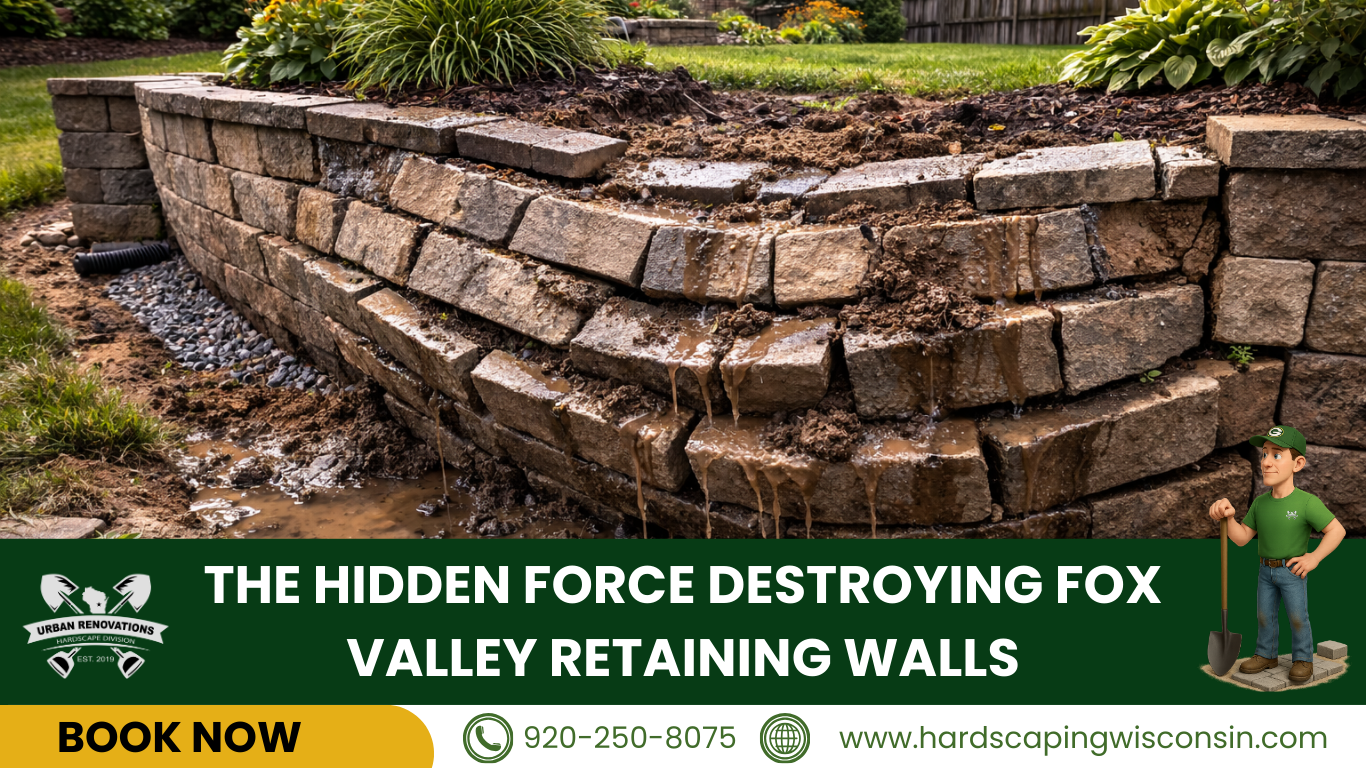
You walk out your back door after a long week of heavy spring rain and glance across the yard. Something is off. The stone wall holding back your garden hill looks different. It is not sitting straight anymore. The lower blocks are pushing forward, and there is a dark wet stain along the base that was not there before. You tell yourself it is probably just settling. It is not. What you are seeing is a structural failure already in progress, and the cause has been building silently underground for months.
Retaining walls do not fail suddenly. They fail gradually, block by block, as a force most homeowners never think about accumulates behind the stone and pushes outward with increasing power. By the time the bulge is visible from your back door, significant damage has already been done to the foundation. Understanding what is actually happening behind that wall changes how you evaluate contractors, ask questions, and make decisions about protecting your property.
What Causes a Retaining Wall to Bulge, Lean, and Collapse?
Retaining walls fail almost entirely due to one cause: trapped water. When groundwater builds up behind a wall with no clear path to escape, it creates a force called hydrostatic pressure. According to the Southern Loss Association, most retaining wall failures occur because of groundwater or soil moisture accumulation building pressure against the structure, with that pressure increasing the deeper the water level rises. A cubic foot of water weighs over sixty-two pounds. When hundreds of cubic feet collect behind your stone blocks during a Wisconsin spring, you are dealing with literal tons of outward force pushing against a structure that has no way to flex or absorb it.
The pressure does not distribute evenly. It compounds with depth, which is why you almost always see retaining walls bulge outward at the lower and middle sections first. The water is searching for any path of least resistance, and if the builder did not engineer a clear drainage route, the wall itself becomes that path. Hydrostatic pressure does not announce itself. It works quietly, every time it rains, until the structure can no longer hold.
Why Wisconsin Red Clay Makes This Problem Worse
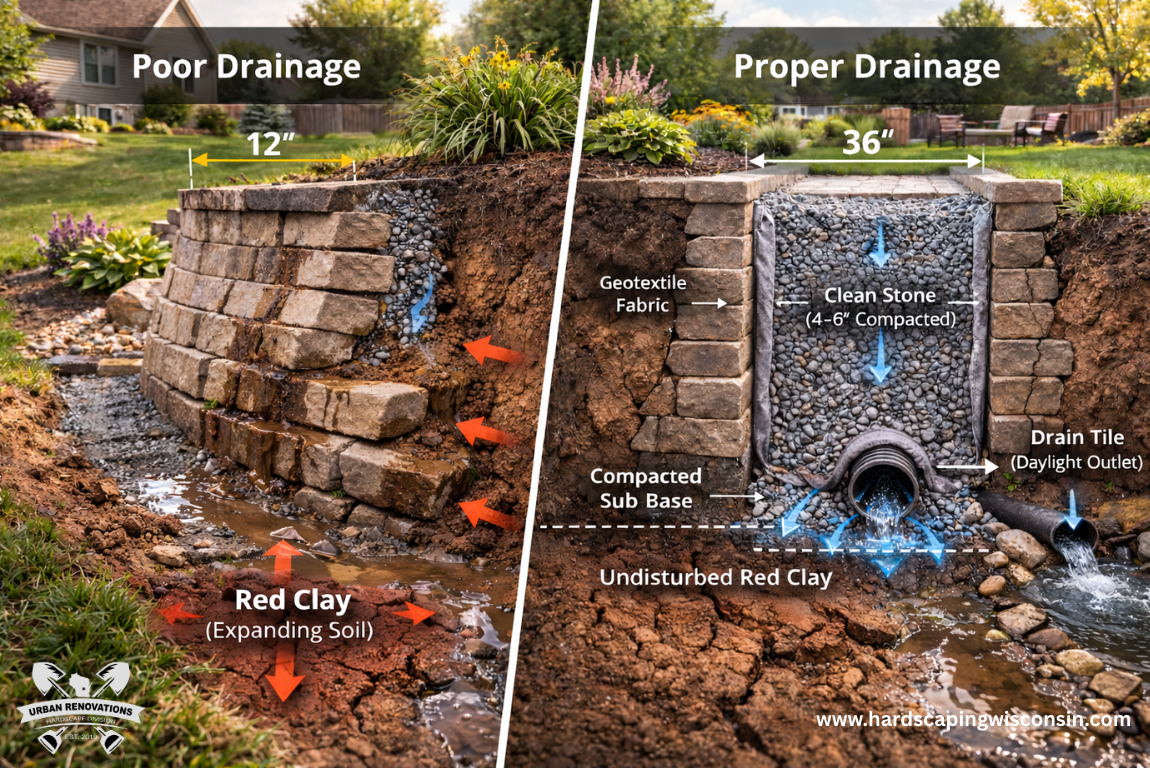
Every soil type behaves differently around water. Sandy soil lets rainwater drain through quickly and naturally. Fox Valley red clay does the opposite. It is dense, non-porous, and holds water like a sealed container. When heavy spring rains arrive, that clay absorbs moisture and swells, trapping water directly against the back of your wall for days or even weeks at a time. This is why a properly built retaining wall Appleton homeowners can count on must be engineered for our specific soil conditions, not just built to a generic national standard. The hydrostatic pressure during that saturated period is not brief. It is sustained and relentless.
Winter adds another layer of punishment. That same trapped moisture freezes and physically expands against the blocks, a process we cover in detail in our guide on frost heave prevention for retaining walls in Appleton. The spring thaw then turns the saturated clay into a heavy slurry pushing against the stone from behind. This cycle of freeze, thaw, and constant hydraulic pressure is what destroys walls built without serious drainage engineering. Clay soil makes adequate drainage more important in Wisconsin than almost anywhere else in the country.
Why the Industry Standard 12 Inches Is Not Enough Here
Many contractors build to the minimum industry standard: a twelve-inch column of crushed stone behind the blocks. In dry climates, this is often sufficient. In Fox Valley clay, it is not. A one-foot buffer of gravel becomes overwhelmed and mud-contaminated during a single heavy rainstorm. Once that narrow drainage layer clogs, hydrostatic pressure builds immediately and begins forcing the blocks forward. We see the results of this shortcut regularly. A homeowner searching for a reliable retaining wall Appleton contractor calls us after a wall installed just a few years ago has already started leaning. In almost every case, the original builder used twelve inches of drainage stone and considered the job done.
Saving money on drainage gravel is one of the most expensive decisions a contractor can make on your behalf. The cost difference between twelve inches and a proper drainage system is relatively small in the context of the full project. The cost difference between a properly drained wall and a full replacement a few years later is significant. Cutting this corner does not save the homeowner anything. It simply delays the bill.
The Urban Renovations Standard: 36 Inches of Protection
After seeing too many drainage failures, we developed our own building protocol that goes well beyond the minimum. Instead of twelve inches of gravel, we excavate and install a thirty-six-inch wide column of clean crushed drainage stone directly behind every wall we build. This three-foot buffer holds three times the water volume during a heavy storm and drains it away before it ever builds enough pressure to threaten the structure. It is not the easiest or cheapest way to build. It is the right way to build in Wisconsin clay.
If you could look at a cross-section of one of our finished walls, you would see the decorative face stones sitting perfectly vertical on the outside. Behind those stones, a full three feet of clean angular limestone runs the entire height of the wall. Behind that gravel column, a heavy-duty geotextile fabric separates the clean stone from the native red clay, preventing the clay from migrating into and clogging the drainage zone over time. Every Appleton retaining wall builder should be building to at least this standard in our soil conditions, but most do not because it requires more excavation, more material, and more time.
This is not a premium upgrade we charge extra for. It is our baseline standard on every project because we are not interested in getting a call three years later about a wall that needs replacing. If you are planning to install retaining wall Appleton projects and want to understand how structural work connects to the broader outdoor design picture, our guide on the differences between hardscaping and landscaping is worth reading before you start any project.
Why Drain Tile Is the Other Half of the Solution
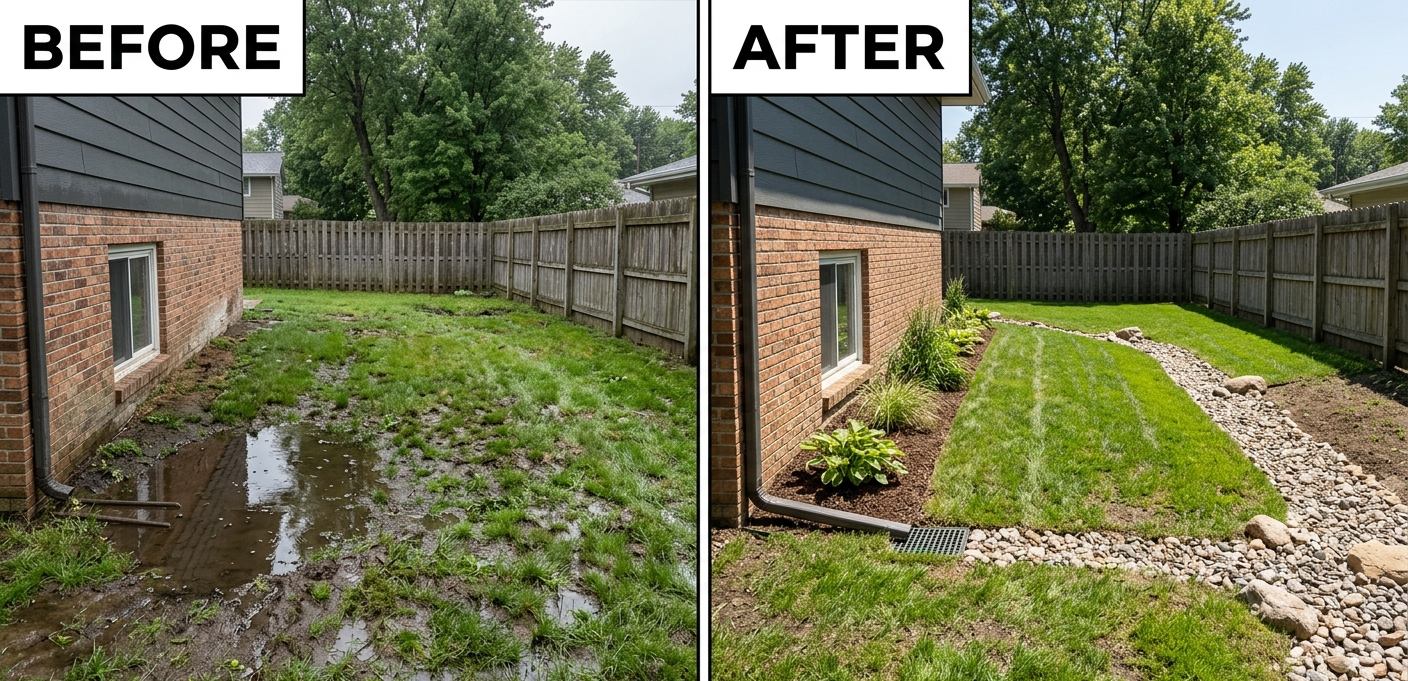
The thirty-six-inch drainage column handles the water while it is moving downward through the gravel. But water reaching the bottom of that column still needs somewhere to go. Without a proper exit, it will pool at the base of the wall and rise until it creates the same pressure problem from below. This is why every wall we build includes a perforated drain tile pipe installed at the lowest point of the drainage trench. Water filters down through the gravel, enters the pipe, and gravity carries it safely away from the structure and out of your yard entirely. Experienced contractors know that the gravel and the drain tile are not two optional extras. They are two halves of a single drainage system, and neither one works properly without the other.
Some contractors skip the drain tile to save time on a single afternoon of work. Without it, the bottom of even a well-drained gravel column becomes a holding pool during a major storm. The water level rises, pressure builds from below, and the bottom courses of the wall begin to shift outward. This is a failure mode that is completely avoidable with a plastic pipe that costs very little relative to the total project. The only reason to skip it is to cut corners.
Warning Signs Your Wall Is Already Under Pressure
Catching hydrostatic problems early saves a repair rather than requiring a full replacement. The most obvious sign is a visible bulge in the lower or middle section of the wall face. Even a small outward bow of an inch or two means significant pressure has already been building behind the blocks. Dark wet staining or mud seeping through the joints after rain is another clear indicator that drainage behind the retaining wall Appleton homeowners rely on has failed and needs immediate attention. Neither of these signs should be watched and waited on.
Pay attention to the ground behind the top of the wall as well. If the soil is sinking, cracking, or holding puddles after rain, the drainage system below has likely become compromised. A wall showing any of these signs needs to be assessed by a professional quickly. Finding a qualified Appleton retaining wall builder to evaluate the damage early is far less expensive than waiting until the wall needs a full replacement. Hydrostatic pressure does not stabilize on its own. It increases every time it rains until the structure can no longer resist it.
What to Ask Before You Hire Anyone to Build or Repair a Wall
Not every contractor who offers retaining wall work understands the drainage engineering behind it. When you are evaluating someone to install retaining wall Appleton projects on your property, ask them exactly how wide their drainage stone column will be. Ask whether they install geotextile fabric between the gravel and the native soil. Ask where the drain tile exits and how it is sized. A contractor who cannot answer these questions confidently, or who tells you twelve inches of gravel is plenty, is giving you important information about the quality of what they will build.
The right contractor welcomes these questions. Just as understanding the difference between structural hardscaping and living landscaping helps you evaluate outdoor projects broadly, our guide on hardscaping vs. landscaping in Appleton covers why structural work always demands a higher level of engineering rigor than planting and garden work. A wall that holds back a hillside in Wisconsin clay requires the same respect for underground forces as any other permanent construction project.
Any reputable company offering to install retaining wall Appleton properties will be transparent about their drainage specifications before they ever discuss stone color or wall height. If they lead with aesthetics and avoid the technical questions, keep looking.
Your Wall Should Be Holding Ground, Not Losing It
If your existing wall is showing signs of movement, or you are planning to build a new one, we would like to help you get it right. As an experienced Appleton retaining wall builder working in Fox Valley clay conditions every season, we know exactly what it takes to build a wall that holds for decades. We build to our 36-inch drainage standard on every project because we stand behind our work and we want you to call us with questions, not problems.
Reach out today to schedule a consultation. We will walk you through the drainage engineering, explain what we find in your specific yard, and give you a realistic picture of what a properly built wall looks like from the ground up. We serve homeowners throughout Appleton and the surrounding Fox Valley communities and we would love to show you what it looks like when this work is done the right way.
About Urban Renovations
Urban Renovations is Central Wisconsin’s one stop team for hardscaping and landscaping, built around clean craftsmanship and a smooth experience from start to finish. They handle everything from paver patios, retaining walls, pergolas, and outdoor kitchens to grading, lawn installation, planting, and drainage that keeps your yard looking right and working right. Their 3D design process helps homeowners see the plan before work begins, so decisions feel confident and surprises stay off the jobsite. From the first conversation to the final walkthrough, their crew keeps communication clear, timelines realistic, and results built to last.

Ready to transform your outdoor space?
Trusted Local Team • Design and Build • Licensed and Insured • Year Round Service
From complete yard makeovers and hardscape installations to mowing and seasonal cleanups, we help Wisconsin homeowners get it done right. Call 920-250-8075 or submit the form below to get started.
Contact Us
Ready to Upgrade Your Outdoor Space?
If you are thinking about a new patio, retaining wall, pergola, or a fresh lawn install, our team is here to help you plan it right and build it to last. Reach out to Urban Renovations to talk through your goals, get expert guidance, and take the next step toward a clean, functional outdoor space you will enjoy for years.
Follow Us
Get A Free Quote Today!